



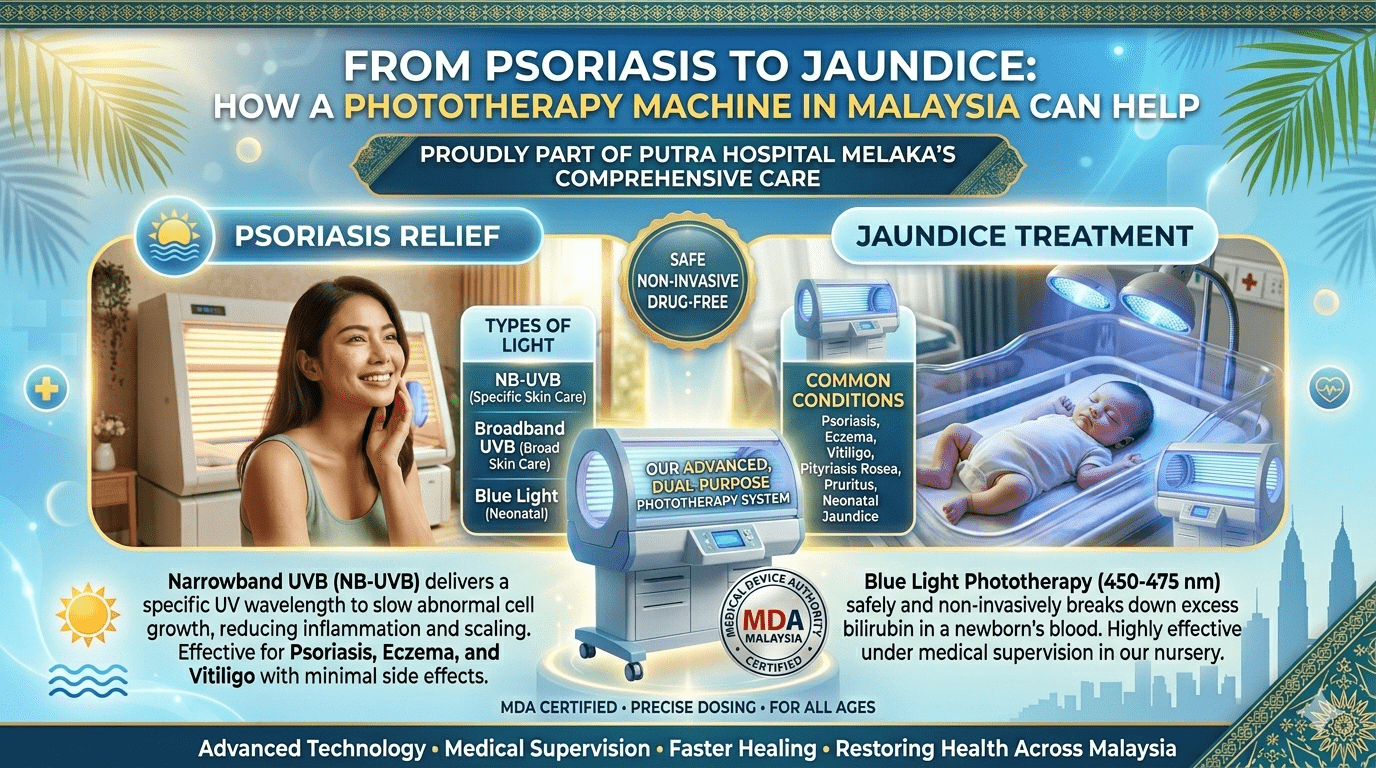
From Psoriasis to Jaundice: How a Phototherapy Machine in Malaysia Can Help
At Rumah Sakit Spesialis Putra Melaka, we have seen how the right treatment can truly change a patient’s life. From newborns receiving blue light therapy for jaundice to adults finally finding relief from long-term psoriasis, the results we see every day remind us why we are so passionate about our work.
Light therapy, also known as phototherapy, has been used in medicine for many years. Today, with advanced technology and precision equipment, it has become even more effective. Hospitals, clinics, and specialist centres across Malaysia are increasingly using phototherapy to treat various medical conditions safely and effectively, often reducing the need for strong medication.
At Putra Hospital Melaka, we are proud to use advanced phototherapy machines to provide better care and improved outcomes for our patients. In this article, we will explain what phototherapy is, what conditions it treats, and why it is becoming an important tool in modern healthcare in Malaysia.
What Is a Phototherapy Machine?
Before we dive into the conditions it treats, let us start with the basics.
A phototherapy machine is a medical device that uses specific wavelengths of light to treat various skin and medical conditions. The light penetrates the skin at a controlled depth, triggering biological responses that help reduce inflammation, slow down abnormal cell growth, break down bilirubin in newborns, and promote overall skin healing.
Types of Light Used in Phototherapy
Different conditions require different types of light. Here are the most commonly used:
- Narrowband UVB (NB-UVB) — the most widely used form of phototherapy for skin conditions like psoriasis, eczema, and vitiligo. It delivers a very specific wavelength of ultraviolet B light that is highly effective with minimal side effects.
- Broadband UVB — an older form of UV therapy that covers a wider range of wavelengths, still used in certain clinical settings.
- PUVA (Psoralen plus UVA) — combines a light-sensitising medication called psoralen with UVA light exposure, often used for more severe or resistant skin conditions.
- Blue Light Therapy — primarily used for treating neonatal jaundice in newborns. The blue light helps break down excess bilirubin in the baby’s blood.
It is important to understand that phototherapy is not the same as simply sitting under sunlight or a regular lamp. A medical device phototherapy machine is carefully calibrated to emit precise wavelengths at controlled doses, ensuring both safety and effectiveness for each patient.
Common Conditions Treated by a Phototherapy Machine in Malaysia
One of the key advantages of phototherapy is its versatility. A single phototherapy machine in Malaysia can help treat a wide range of medical conditions. At Putra Hospital Melaka, we commonly use phototherapy as part of our treatment approach for several conditions.
Psoriasis
Psoriasis is a chronic autoimmune condition that causes skin cells to grow too quickly, leading to thick, scaly, and itchy patches. Narrowband UVB phototherapy is widely used to treat moderate to severe psoriasis. It slows down skin cell growth and reduces inflammation, helping many patients see significant improvement with regular sessions.
Eczema and Atopic Dermatitis
Eczema causes red, inflamed, dry, and itchy skin. For patients who do not respond well to topical creams or want to reduce the use of steroid-based treatments, phototherapy can be an effective and safer alternative.
Vitiligo
Vitiligo causes patches of skin to lose their pigment, creating white or lighter areas. Narrowband UVB phototherapy has shown promising results in stimulating repigmentation, especially when treatment begins early.
Neonatal Jaundice
This is one of the most common conditions we treat using phototherapy at Putra Hospital Melaka. Neonatal jaundice affects many newborns in the first few days of life when bilirubin levels in the blood become too high.
Blue light phototherapy is the standard treatment for neonatal jaundice. The baby is placed under the phototherapy lamp, and the blue light works to break down bilirubin into a form that the body can easily eliminate. It is safe, non-invasive, and highly effective when administered correctly under medical supervision.
Other Conditions
Beyond the above, phototherapy is also used in Malaysia for treating:
- Pityriasis rosea — a common skin rash that can be relieved with UV therapy
- Mycosis fungoides — an early-stage form of cutaneous lymphoma
- Pruritus — persistent itching associated with kidney or liver disease
- Polymorphous light eruption — a type of skin reaction triggered by sun exposure
How a Phototherapy Machine in Malaysia Works in Clinical Settings
If you or a loved one has been referred for phototherapy, you may be wondering what to expect. Here is a simple overview of how the process works in a clinical setting like Putra Hospital Melaka.
Initial Assessment
Before starting treatment, the medical team conducts a detailed assessment of the patient’s condition, skin type, medical history, and any medications they are taking. This helps determine the most suitable type of phototherapy and the correct starting dose.
Treatment Sessions
Phototherapy is usually given through multiple sessions over several weeks. For most skin conditions, patients attend treatment two to three times per week. Each session may last from a few seconds to several minutes, depending on the condition and the patient’s response to the light.
Monitoring and Adjustments
Throughout the treatment, the medical team carefully monitors the patient’s progress. The light dose is gradually increased as the skin builds tolerance. If mild side effects such as redness or irritation appear, adjustments are made to keep the treatment safe and effective.
Safety Measures
Patients are given protective eyewear during sessions to protect their eyes from UV exposure. Certain areas of the body that do not require treatment may also be covered or shielded depending on the condition.
All sessions are supervised by trained medical professionals to ensure the treatment remains safe, comfortable, and effective.
Medical Device Phototherapy — Standards and Regulations in Malaysia
When it comes to medical equipment, quality and compliance are essential. In Malaysia, all phototherapy machines used in clinical settings must meet the standards set by the Medical Device Authority Malaysia, which operates under the Ministry of Health Malaysia.
What Is the MDA?
The Medical Device Authority (MDA) is the regulatory body responsible for ensuring that all medical devices used in Malaysia are safe, effective, and meet quality standards. Any phototherapy machine used in hospitals or clinics must be registered with the MDA before it can be legally used on patients.
What to Look for in a Certified Phototherapy Machine
Healthcare providers should consider several factors when evaluating a phototherapy machine in Malaysia:
- MDA registration — confirms the device complies with Malaysia’s regulatory requirements.
- CE Marking or FDA Approval — internationally recognised certifications that show the device meets global safety and performance standards.
- Documented clinical evidence — the machine should be supported by clinical studies proving its effectiveness.
- Manufacturer support and warranty — reliable after-sales service, spare parts availability, and technical support are important for long-term clinical use.
At Putra Hospital Melaka, we only invest in phototherapy equipment that meets strict regulatory and clinical standards, ensuring our patients receive safe and reliable treatment.
Benefits of Using a Phototherapy Machine in Malaysia
Phototherapy has become an important part of modern healthcare in Malaysia because of the many benefits it offers to patients and healthcare providers.
Non-Invasive and Drug-Free
Phototherapy does not involve needles, surgery, or strong medications. For patients who want a treatment with fewer side effects, or those who cannot tolerate certain drugs, this is a major advantage.
Safe for All Age Groups
One of the key strengths of phototherapy is that it can be safely used for many age groups — from premature newborns with jaundice to elderly patients managing chronic skin conditions. With proper medical supervision, it is considered a very safe treatment option.
Reduces Dependence on Medication
For conditions such as psoriasis and eczema, long-term use of steroid creams or immunosuppressant drugs may carry risks. Phototherapy can help manage these conditions while reducing the need for continuous medication.
Cost-Effective in the Long Run
Although there is an initial investment in setting up a phototherapy machine in Malaysia, the long-term benefits are significant. Effective treatment can reduce hospital visits, lower medication costs, and improve the patient’s overall quality of life.
Widely Available Across Malaysia
Phototherapy is no longer limited to large specialist hospitals. Today, it is widely available in private hospitals, dermatology clinics, and paediatric centres across Malaysia, including at Putra Hospital Melaka in the heart of Melaka.
The Future of Phototherapy in Malaysia
The future of phototherapy in Malaysia is developing quickly, and at Putra Hospital Melaka, we are excited about the progress ahead.
Growing Demand in Healthcare
As awareness of skin conditions and neonatal care increases, more hospitals and clinics in Malaysia are recognising phototherapy as an essential treatment option rather than a specialised service.
Technological Advancements
Modern phototherapy machines are becoming more advanced, energy-efficient, and precise. New features such as automated dose calculations, LED-based light sources with longer lifespans, and real-time monitoring are helping make treatments safer and more convenient.
Home-Use Phototherapy Devices
For patients with long-term conditions like psoriasis or vitiligo, home-use phototherapy devices are becoming more popular. These compact devices allow patients to continue their treatment at home under medical guidance, reducing the need for frequent hospital visits.
Although home devices cannot replace clinical-grade treatment, they are an exciting step toward making phototherapy more accessible to patients across Malaysia.
Conclusion
From treating newborn jaundice to helping psoriasis patients regain their confidence, the impact of phototherapy is meaningful and far-reaching. The phototherapy machine in Malaysia has become one of the most versatile and valuable tools in modern healthcare, and its role will continue to grow in the years ahead.
At Rumah Sakit Spesialis Putra Melaka, we are committed to using advanced equipment and modern treatments to ensure our patients receive the highest standard of care. Whether you are a patient exploring treatment options or a healthcare professional learning more about medical device phototherapy, we hope this guide has provided helpful insights.
If you would like to learn more about our phototherapy services or speak with one of our specialists, we warmly welcome you to contact or visit Putra Hospital Melaka. Our team is always ready to support you on your journey to better health.